
Snow Day Predictor – School Closure Probability Calculator:
A snow day is usually decided hours before sunrise, and families often rely on local forecasts, snowfall depth, temperature, wind chill, and road safety conditions to estimate whether schools will close. This Snow Day Predictor analyses upcoming weather patterns using your ZIP or postal code and converts them into a clear school closure probability. Instead of checking multiple weather reports, you can instantly see tomorrow’s expected snowfall risk, likely timing, and overall conditions in one place.
Check tomorrow’s snow day chances by ZIP or postal code. Get snowfall probability and forecast insights often considered during school closure decisions (Last Updated 01/03/2026, 12.00).
What is Snow Day Predictor?
Wondering if schools might close tomorrow morning?
Our Snow Day Predictor estimates the probability of a school closure or delay using forecast weather conditions and transportation safety factors.
Enter your ZIP or postal code in the calculator above to instantly see the likelihood of a snow day. The system evaluates overnight temperature changes, snowfall timing, and road-icing risk, using the same environmental conditions that school administrators monitor before making closure decisions.
Unlike a simple snowfall forecast, this tool focuses on whether buses can operate safely. Even a small winter storm can lead to a closure when roads freeze before sunrise.

What Your Snow Day Percentage Actually Means
After running the prediction, you will see a percentage value.
This number represents the chance that a school district will decide transportation conditions are unsafe.
Probability | Interpretation |
0-20% | Schools usually open normally |
20-40% | Minor delays possible |
40-60% | A two-hour delay become normally |
60-80% | Closure frequently occurs |
80-100% | Closure very likely |
The prediction does not simply measure how much snow will fall.
It estimates whether morning travel conditions will be considered safe for students waiting outdoors and buses driving on untreated roads.
How Today’s Prediction Is Evaluated
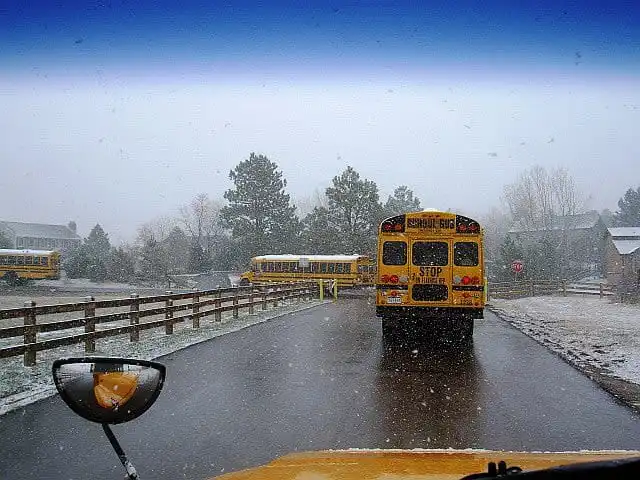
School closures are usually based on transportation safety rather than total snowfall.
The prediction reviews several environmental conditions that commonly influence closure decisions.
Key conditions considered:
- Overnight temperature drop
- Early morning road freezing risk
- Snowfall timing
- Visibility during pickup hours
- Wind chill exposure for students
When these conditions occur together, districts often determine that bus routes cannot operate safely and may cancel classes or delay opening times.
How the Snow Day Prediction Model Works
School closures are rarely based on snowfall depth alone.
Administrators typically evaluate transportation risk.
Our prediction system analyses several combined environmental conditions:
- overnight low temperature
- early-morning temperature at bus start times
- expected snowfall accumulation
- freezing rain or sleet probability
- wind chill exposure for students
- road surface freezing risk
- storm timing (overnight vs morning commute)
- visibility conditions during transport hours
The model calculates the probability that roads will freeze before ploughing operations are completed. If buses cannot safely stop, turn, or climb hills, districts often close schools even when snowfall appears moderate.
A key factor is timing.
Snow falling at 3 PM often does not cause closure.
Snow falling between 2 AM and 6 AM frequently does.
Key Features of Snow Day Predictor:
This tool or calculator can have several key features that one can benefit from to use it for their needs.
School Closure Probability Calculation
This predictor estimates the likelihood that a school district will cancel classes or announce a delay.
The percentage result is not a snowfall forecast; it represents a decision probability based on conditions that typically lead administrators to close schools. The model evaluates temperature patterns, overnight accumulation, and early morning safety risks to determine whether transportation conditions are likely to be considered unsafe.
A higher percentage means schools are increasingly likely to cancel in order to avoid student travel during hazardous conditions.
Transportation Safety Risk Analysis
School closures are primarily based on transportation safety rather than snow depth.
The system evaluates whether buses can operate safely on neighborhood streets, rural roads, and intersections during early morning hours. It considers braking distance, turning safety, hill travel, and pickup visibility conditions.
Even moderate winter weather can lead to closures if road traction and driver visibility fall below safe operating limits for school buses.
This allows the tool to reflect real-world decision-making used by school administrators.
Road Ice Detection
Ice formation is one of the most common reasons schools close.
The predictor analyzes overnight temperature changes and identifies when melting snow is likely to refreeze before sunrise. Bridges, shaded streets, and untreated residential roads freeze first and significantly increase accident risk for buses.
Because ice is difficult to see and harder to control than snow, districts frequently cancel school even with light snowfall when freezing conditions are present.
The model prioritizes icing risk more heavily than snowfall totals.
Overnight Storm Timing Analysis
The timing of a storm is often more important than its size.
Snow falling overnight has a much greater impact on school operations than snow occurring later in the day. The system checks whether precipitation is expected between late night and early morning hours, the period when plows have limited time to clear bus routes.
If snowfall occurs shortly before morning pickup times, the closure probability increases because roads cannot be treated safely before buses begin operating.
Morning Commute Condition Monitoring
Schools focus on the hours when students travel, not the entire day’s weather.
The predictor analyzes conditions during the typical morning commute window when students wait outdoors, and buses are active. Low temperatures, strong wind chill, and reduced visibility increase safety concerns.
Even when daytime weather improves, hazardous early morning conditions often lead to delays or closures. This feature helps the prediction align with real transportation schedules rather than general weather forecasts.
District-Based Regional Modeling
Different regions respond to winter weather differently.
Areas that experience snow frequently often remain open during moderate storms, while regions with limited winter preparation may close quickly for safety. The model accounts for regional behavior patterns and infrastructure readiness.
Urban districts with treated roads may operate normally, while rural districts with long bus routes may close earlier. This allows predictions to match better local expectations rather than applying a single national standard.
Continuous Forecast Recalculation
Weather forecasts are updated many times overnight.
Each time forecast data changes, the system automatically recalculates the school closure probability. Small temperature adjustments can significantly change ice formation and road safety, so predictions remain dynamic rather than fixed.
Users may notice percentage changes between evening and morning checks. This indicates the model is responding to new environmental conditions and improving prediction reliability.
Live Data Update Tracking
The tool uses current forecast patterns and continuously monitors new weather inputs.
A visible timestamp shows when the prediction was last refreshed, so users know the estimate reflects recent conditions. Checking again, closer to morning provides the most accurate expectation.
This helps families plan alarms, transportation, and childcare while waiting for official school announcements.
Who can get benefits from the Snow Day Calculator?
Why use our Snow Predictor?
The one who uses this tool can easily get the answer to this question. No other tool can give you such accurate data with a consistent flow to get tomorrow’s snowfall prediction. It deals with real-time weather forecasts for users living in their desired district or city.
Now, some people will say, “How can we predict for other states and regions of the USA and Canada?”
This is a probability-based decision support tool designed to help families prepare for potential school delays or closures. The system interprets weather patterns and transportation safety indicators commonly used by school districts when determining whether buses can operate safely.
The predictor does not issue official closure announcements. Always rely on your local school district’s official communication for final decisions. Its purpose is to give an early expectation so families can plan alarms, childcare, and morning schedules.
FAQs:
Conclusion:
That’s it! Let me summarise all the information about the snow day predictor. First, the user reaches out to us, and then they want to know the snowfall chance for tomorrow. Then, they use their current zip code or postal code to predict the likelihood of snowfall in their district. Simple! That’s how the Snow Day Predictor algorithm works. However, be sure to search for a more reliable snow day predictor, like ours, to obtain accurate results. As the Snow Day Calculator, accuracy is way more important for deciding the next day’s activities.