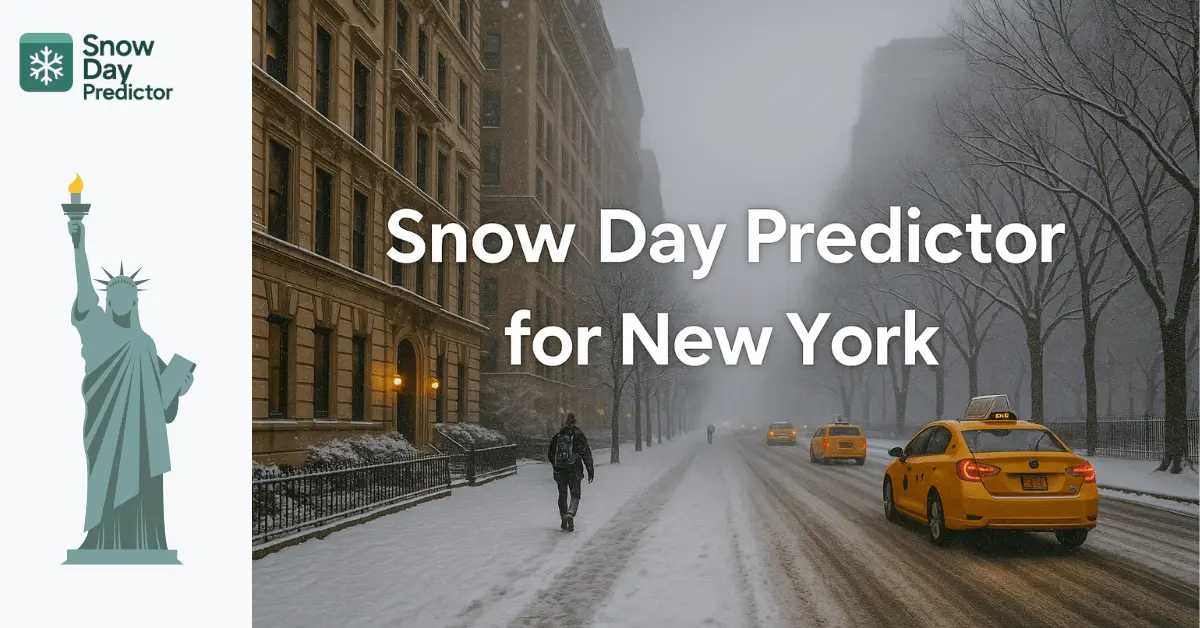
Snow Day Predictor for New York – Latest Guide in 2026
Winter in New York can be unpredictable. Like you can’t predict the next day’s weather forecast from your own thoughts. One day, it’s calm, and the next morning, you wake up to several inches of snow covering your street, house, and cars. Students, parents, teachers, and frequent travellers across New York often wonder the same thing:
“Do we have a snow day tomorrow?”
This page provides a state-specific, data-driven, accurate snow day prediction guide for New York, using a combination of weather indicators, school district policies, and historical closure trends.
Below, you can access the Snow Day Predictor for New York, understand how it works, and learn how New York’s climate impacts school closures.
This guide follows trusted data sources including the National Weather Service (NWS), NOAA, and local school district announcements, ensuring helpful, experience-backed information.
Snow Day Predictor for New York – Quick Overview:
New York is known for heavy winter activity, from lake-effect snow in western and northern NY to nor’easter storms hitting New York City and Long Island. Here’s what typically influences snow days across the state:
- Lake-Effect Snow (Buffalo, Rochester, Syracuse).
- Nor’easters (NYC metro area).
- Polar vortex cold waves (upstate regions).
- Blizzard conditions are causing visibility issues.
- Icy roads on morning commutes.
- Strict school district safety policies.
New York experiences frequent snowfall between December and March, making accurate predictions essential for parents, teachers, and those who travel a lot.
Use the Snow Day Predictor for New York:
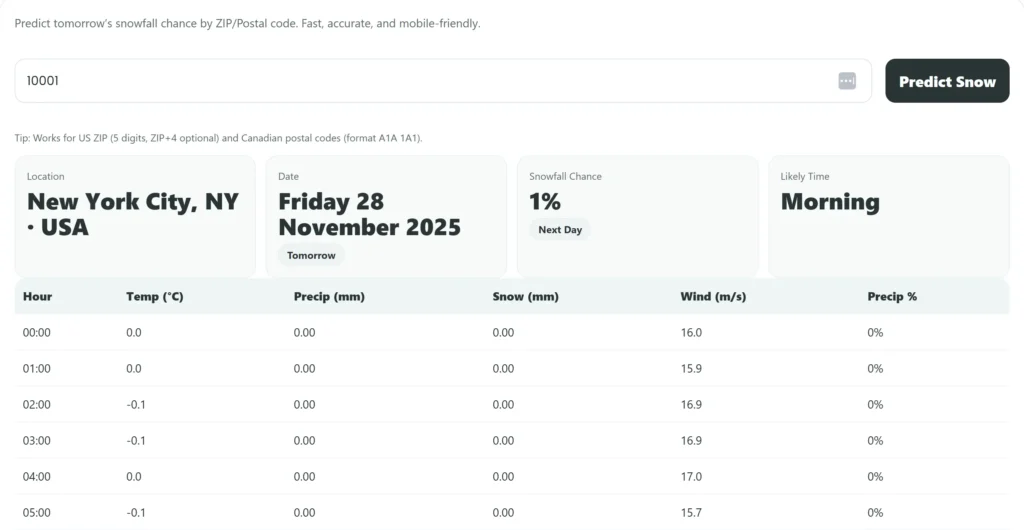
Want to Predict on your own? If yes, type 10001 Zip Code of New York in the tool below and check the chance of snowfall.
Predict tomorrow’s snowfall chance by ZIP/Postal code. Fast, accurate, and mobile-friendly.
This predictor analyzes multiple weather indicators, including
- Chance of snowfall for tomorrow.
- Hourly data for tomorrow’s temperature, wind flow, and precipitation.
- The likely time when the snowfall occurs (morning, evening, or night).
- Storm advisory level (NWS).
- Timing of snowfall relative to school hours.
It’s designed to give New York students and parents a clear, simple answer based on real-time data.
Factors That Affect Snow Days in New York Schools:
Snow days in New York depend on several weather and safety metrics. Below are the most influential factors:
Snowfall Accumulation (Inches of Snow Expected):
Generally:
- 2–4 inches → Low chance of closure
- 4–7 inches → Moderate disruption
- 8+ inches → High likelihood of closure or delay
Road & Transportation Conditions:
Schools closely monitor:
- Icy roads can be very lethal in such severe cases, as the New York Department of Transportation (NYSDOT) is very much active and strict regarding this issue, and they take immediate action to clear the busiest roads and streets for public safety.
- Black ice appears on roadsides and streets, making it difficult for people to walk on.
- Frozen bus stops can be very irritating for parents and students, as they will be very uncomfortable standing there for a long time.
- Some unpaved streets can even be used for travelling.
- Public school transportation gets delayed due to the road blockage.
Timing of the Snowfall:
Late-night or early-morning snowfall leads to:
- Higher chance for school delays
- Sometimes schools get fully closed due to unexpected snowfall timing.
- Hazardous morning commutes, as sometimes snowfall gets wild and dangerous.
Wind Chill & Temperature Advisory:
Polar vortex events often push temperatures far below freezing.
- Wind chills below −10°C can trigger school closures.
- Frostbite risk is considered for students walking to bus stops.
School District Safety Policies:
Each district has its own rules, for example.
- NYC Department of Education.
- Buffalo Public Schools.
- Syracuse City School District.
- Rochester City School District.
If road crews can’t make routes safe, then there is a higher chance of school closures for student safety, and there are some other departments that are strict on individual life rather than their normal daily routine.
Historical Snow Day Predictor for New York:
New York has a long history of winter disruptions, especially in regions like
- Buffalo (heavy lake-effect snow).
- Syracuse (one of the snowiest cities in the U.S.).
- Rochester (frequent blizzards).
- Watertown (very high snowfall).
Patterns to note:
- Buffalo often gets multiple snow days every winter.
- NYC sees fewer closures, but nor’easters cause widespread shutdowns.
- Upstate districts close more frequently than downstate.
Winter Weather Patterns in New York:
New York’s winter is shaped by multiple weather systems:
Lake-Effect Snow:
- Triggered by cold air passing over Lake Erie and Lake Ontario.
- Affects: Buffalo, Rochester, Oswego, and Syracuse.
Nor’easter Storms:
- Hit Long Island, NYC, and Westchester.
- Cause heavy snow and strong winds.
Polar Vortex Events:
- Bring extreme cold and wind chill across the state.
Plains Storms:
- Move eastward and impact upstate New York.
Accuracy of Snow Day Predictor for New York:
Prediction accuracy depends on:
- Storm path changes.
- Temperature fluctuations.
- Storm speed.
- Local school district thresholds.
- Microclimates (NYC vs. Syracuse have VERY different snow patterns).
Our Snow Day Predictor uses:
- Real-time NWS alerts.
- NOAA radar data.
- Local storm tracking.
- Historical closure trends.
This makes it highly reliable for the New York region, especially when storm intensity is stable.
Tips for Students & Parents on Snow Days in New York:
- Check NWS weather alerts regularly.
- Stay updated with local school district notifications.
- Prepare warm clothing for severe cold waves.
- Avoid unnecessary travel during blizzards and snowstorms.
- Keep emergency supplies ready (flashlights, batteries, blankets).
- Use a reliable and the best snow predictor, like ours, to check the chance of a snowfall.
Cities in New York Covered by Our Predictor:
This tool covers all major and minor New York regions, including:
- New York City.
- Buffalo.
- Rochester.
- Syracuse.
- Yonkers.
- Albany.
- Binghamton.
- Niagara Falls.
- Watertown.
Want to see the snowfall chance for these cities as well?
Use our full-fledged Snow Predictor tool. By checking the zip codes.
And over 200+ school districts across the state.
FAQs:
Conclusion:
Winter in New York is powerful, unpredictable, and exciting, but it can also disrupt daily life. Whether you’re a student hoping for a day off, a parent planning ahead, or a frequent traveller who mostly travels for business, our Snow Day Predictor gives you quick, reliable, and state-specific forecasts.
Well, I think most of the doubts of the Snow Day Predictor for New York have been cleared, as we have highlighted the basic and most important factors and issues that need to be kept in mind in the winter season for those living in New York. I personally experienced such an issue in New York during a severe winter, and because of this, I thought of helping the people of New York.
Keep yourself safe, warm, and updated in these conditions while living in New York. As Christmas is coming ahead, I don’t want any family member or person to be affected and miss out on the pleasant evening of Christmas.